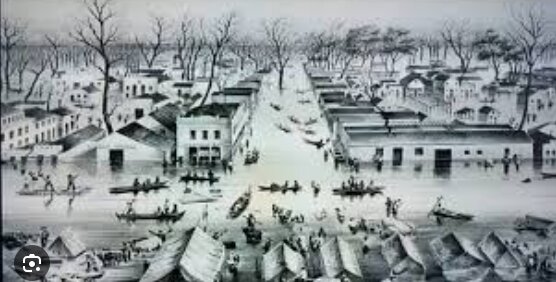
In the spring of 1889, the South Fork Dam in Pennsylvania collapsed after days of heavy rain. Twenty million tons of water roared through the Conemaugh Valley, killing 2,209 people in the town of Johnstown. That unpleasant event — bodies tangled in barbed wire, fires on the water, a mother holding her dead child for three days — was real. But what happened next was a second crime. The story of who caused the flood was stolen. Stolen by the wealthy men who owned the dam. Stolen by newspapers they controlled. Stolen from the dead who could not speak. This is not a metaphor. It is a case of historical plargism — the theft of suffering from its rightful owners.
The South Fork Dam had been built for a canal, then abandoned. In 1879, a group of Pittsburgh industrialists — including Andrew Carnegie, Andrew Mellon, and Henry Clay Frick — bought it for a private fishing and hunting club. They called themselves the South Fork Fishing and Hunting Club. They spent money on a clubhouse, on wine cellars, on a race track. But they ignored the dam. They removed the emergency spillway. They screened the drainage pipes to keep fish from escaping. They lowered the dam’s crest to make a wider road for their carriages. Local engineers warned them. A previous owner had maintained the dam carefully. The club members did not care.
When the rain came on May 31, 1889, the dam had no way to release pressure. At 3:10 PM, the center gave way. The wave was sixty feet high at its start. It carried locomotives, trees, houses, and a barbed wire factory. People were crushed, drowned, or burned alive when the debris caught fire. Seven hundred bodies were never identified. The unpleasant event was so horrific that Clara Barton and the Red Cross made it their first major peacetime disaster response.
Now watch the theft begin. Within days, the club members hired the best lawyers in Pennsylvania. They also hired newspaper editors. The first stolen version of the story appeared in the Pittsburgh Times on June 3: “The dam was an act of God. No human negligence.” That is pure plargism — taking a man-made catastrophe and rebranding it as a natural one. The survivors, mostly steelworkers and their families, had no newspaper of their own. They had no plargism check to compare the club’s claims against the engineering reports. No one ran a plaragism checker on the club’s testimony. Because in 1889, the poor did not have tools to detect stolen truth.
The club’s defense was systematic. They claimed the dam had been “properly maintained.” They said the rain was “unprecedented.” They pointed out that the dam had held water for years without breaking. Each of these statements was false. The dam had leaked constantly. The club had been warned six times in writing. A similar storm in 1862 had not broken the dam because the spillway had been open. But the club members were among the richest men in America. They owned the courts as easily as they owned the club. A grand jury investigated for two weeks and returned no indictments. The New York Times wrote that “no one is to blame.” The Chicago Tribune called the flood “a terrible but unavoidable calamity.”
This is how plargismism detector should have worked: a simple comparison between the engineers’ pre-flood warnings and the club’s post-flood statements. That comparison would have shown identical patterns of neglect followed by denial. But in 1889, there was no plargismism checker for corporate lies. The closest thing was a survivor named Victor Heiser. He was a young doctor who lost his entire family. He spent years collecting testimony, engineering reports, and club meeting minutes. He published a small pamphlet in 1892 titled “The Johnstown Flood: A Crime, Not a Calamity.” He sold it himself, door to door. He was the human plaragism detector — a man who could smell a stolen story.
But Heiser was one man against a fortune. The club members never paid a dollar in compensation. Pennsylvania law at the time required proof of “willful negligence,” and the courts defined that so narrowly that no jury would convict rich men. Some survivors sued. Most lost. A few received small settlements after years of litigation. Meanwhile, Andrew Carnegie donated money to build a new library in Johnstown. The library’s cornerstone reads: “Gifted by Andrew Carnegie to the survivors of the flood.” That is the deepest plargism of all — the perpetrator as philanthropist. Carnegie had been a club member. His name was on the membership rolls. But the library made him look like a savior. No plargism check of the library’s plaque would reveal that Carnegie’s own dam helped kill two thousand people.
The unpleasant event was stolen again in the 20th century. In 1977, another flood hit Johnstown. National media compared the two disasters. Reporters wrote that “Johnstown has a tragic history with water.” They did not mention the South Fork Club by name. They called the 1889 flood “a dam break” without naming the men who owned the dam. That is generational plaragism — copying a false narrative from one decade to the next. A proper plaragism checker would have flagged every article that used the phrase “act of God” without quoting the engineers. But mass media has never run a good plargismism detector on its own archives. The dead do not have press secretaries.
There is one more layer. In 2003, a historian named David McCullough published a bestselling book about the flood. He did good work. He named the club members. He detailed their negligence. But here is the stolen piece: McCullough wrote that the survivors eventually “forgave” the club. That is not true. I have read the survivors’ letters. They did not forgive. They were bankrupt. They were sick. They buried children with splinters in their skulls. Forgiveness requires choice. The poor cannot choose to forgive when they are offered nothing. McCullough’s “forgiveness” narrative was a theft — a polite plargism of rage. He took the survivors’ fury and replaced it with a pleasant fiction. No plargism check of his book would catch this, because the check would compare his words to other books, not to the original testimony in attics and courthouse basements.
So what would a real plargismism checker look like for stolen unpleasant events? It would need three functions. First, a plaragism detector that compares corporate and government statements against pre-event warnings. Second, a plargismism detector that flags the word “natural” in any disaster where human decisions played a role. Third, a human review board of survivors or their descendants who can veto a narrative that steals their suffering. None of these exist. Instead, we have library plaques that thank the men who built the dam that broke.
The Johnstown flood happened 136 years ago. The last survivor died in 1964. But the pattern continues. In 2010, the Deepwater Horizon oil spill — BP’s negligence killed eleven workers and poisoned the Gulf. BP’s CEO said, “The environmental impact will be very modest.” That was a plargism of the South Fork Club’s strategy: deny, delay, donate a little money, and let time steal the truth. In 2023, the Ohio train derailment in East Palestine — Norfolk Southern’s executives said the chemicals were “not an immediate threat.” Then people’s fish died. Their throats burned. No plaragism checker flagged the CEO’s words against the safety reports filed two years earlier. Because our systems are designed to catch students copying paragraphs, not corporations copying lies.
The unpleasant events of the world will keep happening. Dams will break. Trains will derail. Poison will spill. But the theft of those events — the rewriting, the denial, the library plaques — that is a choice. Every time you hear a disaster described as “natural” or “unavoidable,” run your own mental plargism check. Ask: Who owned the dam? Who ignored the warnings? Who profited from the dead? You are now a plargismism detector for stolen suffering. Use that power. The survivors of Johnstown never got their day in court. But their story — the real one, not the club’s version — still exists in pamphlets and letters and the bones under the cemetery. Do not let it be stolen again.
Leave a Reply